AI Strategy for Business Leaders: Avoiding Artificial Idiocracy | Good Dog Design
AI strategy for business owners, Organizations, and Enterprises.
AI does not replace the need for wisdom, but will amplify the consequences of its absence.
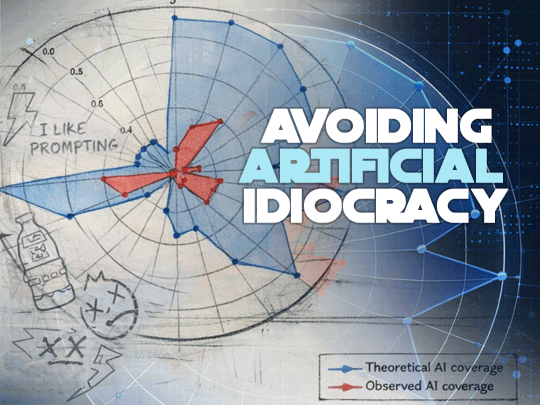
Every decade or so, a technology arrives that fundamentally changes how we work. We have surfed the chaotic bubble of the early internet, the mobile revolution, and the rise of social and business platforms. Each brought faster and deeper societal change than the last and in each case, the advantage went not to who moved first, but to those that thoughtfully understood what they were actually dealing with.
Waves of Change
AI is undeniably that wave now. It is moving exponentially faster, reaching further, and disrupting more industries simultaneously than anything before it. Previous waves unfolded over years. AI capabilities are compounding quarterly. Businesses are being pushed into decisions before they feel ready to make them, caught between stakeholder pressure, genuine opportunity, and the anxiety of falling behind.
However, speed without judgment creates a different kind of risk, one that is quieter, and considerably more expensive to undo.
AI is already doing a version of the job, faster and cheaper
"AI won't take your job, but someone using AI will."
The moment above has passed.
Thinking, analysing, writing, deciding, communicating, planning, AI is already doing a version of that work. In a growing number of cases it is doing it remarkably well. Contracts reviewed in minutes. Research synthesised in seconds. Code written, tested and documented before a human developer has finished their coffee. The pace has fundamentally accelerated. This is a real and significant progression and should be taken seriously.
However, here is what rarely gets said in the same breath. AI is extraordinary at pattern recognition and generating plausible-sounding outputs at speed. Frontier models can reason across complex domains in ways that genuinely surprise even the most experienced practitioners. However, what it lacks is an understanding of knowing whether those outputs are right for your specific organization, your customers, your legal context, or your competitive position.
It has no stake in the outcome.
It cannot feel the consequence of a bad recommendation. It will confidently produce the wrong answer, especially if the wrong question is asked, and it produces it much faster, at greater scale, and with considerably more confidence. More capable systems can produce more convincing errors. The outputs become harder to question precisely because they become harder to distinguish from authoritative work.
Avoiding Artificial Idiocracy
Idiocracy is a 2006 comedy that has slowly become something closer to a documentary. A society that gradually outsources so much critical thinking that when a genuine problem arrises, nobody is left who knows how to solve it.
We call the AI version of this Artificial Idiocracy: the widening gap between what AI generates and the human judgment required to use it wisely.
What's at risk isn't just headcount. When organizations shed the people who actually understood their work, they lose something harder to replace: the accumulated, specific knowledge that lets someone look at an AI output and know, from experience, that something is wrong, even when it looks entirely right.
Those who remain get stretched thin: accountable for more output across more domains than any one person can realistically evaluate. The proprietary knowledge that once set an organization apart quietly gets traded for speed and fluff. The less people understand the systems they're relying on, the less equipped they are to question what those systems produce.
It compounds silently until something goes wrong in a way nobody anticipated, because nobody left knows where to look.
It is not hypothetical. We are already seeing it everywhere.
- Marketing teams publishing AI-generated content that nobody reviewed for accuracy or brand fit.
- Developers shipping AI-written codebases they are unfamiliar with that nobody fully understands with included automated testing while the system still fails in ways nobody anticipated.
- Business leaders making strategic decisions based on AI summaries of reports they never read.
- Organizations feeding their most valuable proprietary knowledge into AI systems without understanding where it goes or how it's used.
- Businesses hollowing out their own workforce, cutting the roles that were never just about the work but about how knowledge was passed on.
None of these failures are caused by AI being incompetent or malicious. They are caused by humans abdicating the judgment. AI can approximate judgment but cannot own the consequences of it. The people who benefit most from AI outputs are frequently not the same people who bear the consequences when those outputs are wrong.
This is where Artificial Idiocracy lives, not in AI's inability to reason, but in humans assuming that reasoning without accountability is enough.
What Governing AI Actually Looks Like
As AI capabilities grow, the premium on human skills grows with them: taste, strategy, systems thinking, ethical judgment, and the experience to know when something that sounds right is actually wrong.
The organizations that will struggle are not the ones who fail to adopt AI. It is those who adopt it without the wisdom to govern it. Create structures where the consequences of AI-assisted decisions are visible to the people making them. Treat accountability not as a compliance requirement but as the mechanism that keeps judgment honest.
Governance is not a policy document. It is people with the right expertise in the right places, with clear accountability for what the AI produces. It is a strict maintenance of knowledge.
Why Experience Is the Differentiator
When everything that can be automated is automated, what is left? That is not a rhetorical question. It is the most important strategic question a business leader can ask right now.
AI is rapidly commoditising general knowledge. The analysis your competitor can generate in seconds, you can generate in seconds. What then separates your organization from another?
The answer is different for every organization, but the shape of it is always the same. Relationships. Reputation. Contextual judgment. The ability to make a call that no model can make because it requires understanding that cannot be reduced to data.
That is the differentiator. The question is whether this proprietary knowledge is being leveraged or quietly traded away in the rush to adopt.
Getting It Right : Questions Worth Asking Right Now
Before committing to any AI tool or strategy, start with the questions. These are not technical questions. They are leadership questions. And they deserve honest answers before the tools are switched on.
- Where does AI genuinely accelerate competitive advantage, and where does it simply generate more noise?
- How does AI adoption affect the experience and trust of the customers, clients and actual people served?
- Who in the organization has the expertise to evaluate what it is actually producing.
- What data is feeding into these systems, and under what terms?
- Who in the organization is accountable for AI decisions and their consequences? What frameworks exist?
- Most importantly, is the organization adopting AI because it creates real value, or because the pressure to appear current has become impossible to ignore?
How Good Dog Can Help
We've been building thoughtful technology partnerships with organizations for over three decades. AI doesn't change that, it raises the stakes for doing it our best.
We work with clients in a few concrete ways: helping evaluate which AI tools are actually worth adopting for their specific context, building custom AI integrated applications that fit the way their teams actually work, developing strategy and governance frameworks so there are real humans accountable for real outputs, and maintaining those systems over time so they don't quietly drift from useful to risky.
We're not here to sell AI enthusiasm. We're here to be a partner who understands both the technology and your organization well enough to give you an honest read and to build something that holds up.
If that sounds like what you're looking for, we'd love to talk.